


The locksmith industry grows year-on-year here in the UK and becoming a locksmith can be a very lucrative and rewarding career choice if you're willing to put in the hours and don't' mind leaving the house to go out on a job at 3am on a Sunday morning because someone drank too much and lost their keys or regularly get up and 4am to change locks on property where the tenant is being evicted.
Over the last 18 months a lot of people have been made redundant or have just left their insecure job and opted for self employment, and a career as an independent locksmith is one of those careers that wasn't effected by lock downs and other coronavirus restrictions because the industry is classed an essential service just like plumbers, electricians, drain companies etc.
Pandemic or not, people will continue to get locked out of their home, office or vehicle and require emergency entry and people and companies must still make sure that their homes and businesses premises are secure. Landlords will still need to evict non-paying tenants and people moving home will still require that the locks are changed on their new home.
There are a number of other business sectors that are what's known as lock down proof but during the last 18 months the locksmith industry has seen the largest growth, but why?
To train and qualify as a heating engineer or an electrician takes many, many months of practical and written work and both these industries have some form or regulation. Some may argue that there is nothing in law that states that an electrician needs to be NICEIC certified or registered. However, just as you might not employ a builder without a CSCS card, you wouldn't hire an electrician without NICEIC certification because of the issue it can cause in the future and when it comes to residential customers most solicitors and conveyancers will typically ask for certification and documentation for any electrical work you have had done and as no rational electrician is going to put their name to someone else's work, using an amateur electrician can be costly if you are planning on selling your home so as a rule even residential customers are looking for a registered electrician and will simply scroll past any electrician they see on Google or trade websites such as trust a trader, checkatrade etc who doesn't mention qualifications and certification so there are hardly any unqualified electricians around.
The locksmith industry however is totally different; it is as yet completely unregulated with no governing body and until recently no universally recognised training standard which opened up the industry to rogue traders, unqualified amateurs and crash course training companies.
We said until recently there was no universally recognised standard but this all changed in 2019 when Ofqual (The Government Office of Qualifications and Examinations Regulation) regulated two vocational locksmith training courses the Level 3 Diploma in Commercial Locksmiths & Property Security and the Level 3 Diploma in Automotive Locksmiths & Vehicle Security which whilst these are now recognised in the industry as the official standard there is still no Gov't regulation saying that you must take the official courses before trading as a locksmith so there are still a number of training centres who offer sub standard, 3 or 5 day locksmith training courses. We call them crash courses in the industry.
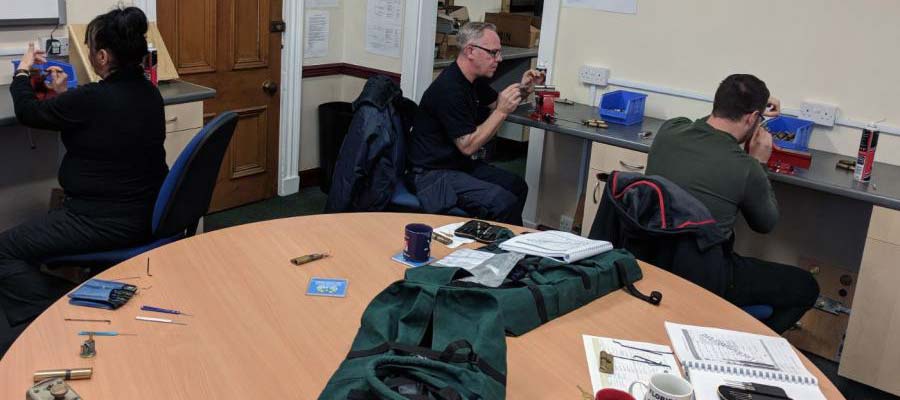
Smaller class sizes means every student gets 100% attention
When these new official Ofqual locksmith training courses were released most decent locksmith training centres already had college status meaning that they were officially recognised and registered as a colleges or higher learning centres and had fully qualified teaching staff so switching to the official courses wasn't a problem. The training centres that didn't switch over and continued to run their own private courses either didn't meet the standards you need to meet to run Ofqual courses or were rogue training centres in the first place set up to run cheap courses and get as many people through the door as possible.
The official courses take many months to complete and are very in-depth consisting of a number of modules containing both practical and written work. You'll finish the courses fully qualified with the knowledge needed to confidently offer domestic, commercial and/or automotive locksmith services.
Compare this to a course that last 3 or 5 days and you'll understand why there are so many rogue locksmiths out there unnecessarily drilling locks, damaging property and overcharging.
Surely these people know that they are not going to learn a lot in 3/5 days yet lots of people still choose these crash courses
There are a couple of reasons why someone would choose a course that lasts 3/5 days compared to a course that takes many months to complete, one reason is the cost, these crash courses cost a few hundred pound compared to the official courses that cost a few thousand. Another reason is that you can start trading and touting for work in less than a week.
The truth is that after 3 or 5 days of training you are only going to learn a few basics, one of these basics is where to drill a lock and this is why an amateur locksmith will immediately reach for their drill and not attempt to pick the lock, and doing this continuously is going to eventually give the locksmith a bad name forcing them to hide behind a national locksmith call centre who will take a cut of their work and/or charge a monthly or annual fee to be on their books, so to speak.
A national locksmith call centre is simply a company that advertises nationwide, some claim to be a national locksmith firms but don't actually employ any locksmiths, they are just contacting an independent locksmith nearest to you.
So taking that extra time to learn the trade and be proficient in it will pay off in the end allowing you to stay independent, get good feedback and build up a decent customer base and maybe even some contract work from the police, the local council or private housing associations.
If your decision is based on your finances and the fact that the official course costs a lot more than the crash course then you haven't understood what officially recognised and government regulated means. Because these are official Ofqual courses there is a number of funding and grant options that are not available with private courses allowing some people to get help toward their training of even train for free. Check out the Locksmith Grants, Funding and Finance options here.
In Summary
Don't choose a cheap, short private locksmith training course when there are official Ofqual courses now available because as time goes by more and more businesses and people will decide to only